
Kawasaki Ninja H2R
The Game Changer Returns – Ninja H2R
Why the Ninja H2R
23 highlights
In-house-designed Supercharger
The supercharger used in the Ninja H2R was designed by Kawasaki motorcycle engine designers with assistance from other companies within the KHI Group, namely the Gas Turbine & Machinery Company, Aerospace Company, and Corporate Technology Division.

Aerodynamically-designed Bodywork
It is no accident that when viewed from the side, the Ninja H2R does not seem to have the aggressive forward-canted stance of most modern supersport models.

Electronic Throttle Valves
Kawasaki’s fully electronic throttle actuation system enables the ECU to control the volume of both the fuel (via fuel injectors) and the air (via throttle valves) delivered to the engine. Ideal fuel injection and throttle valve position results in smooth, natural engine response and the ideal engine output. The system also makes a significant contribution to reduced emissions

Power Unit Designed to Withstand 300 PS Output
Despite it’s familiar In-Line Four configuration, the Ninja H2R power unit is loaded with technology developed specifically for this supercharged engine: some new, others with know-how from the Kawasaki Group.

Dog-Ring Transmission
To facilitate smooth, quick shifting, a dog-ring type transmission was selected. This is the kind of transmission commonly found in MotoGP or Formula 1, and was developed with feedback from the Kawasaki Racing Team.

Downforce Generation
In place of mirrors, the Ninja H2R features CFRP wings mounted on the upper cowl.

Full Titanium Exhaust System
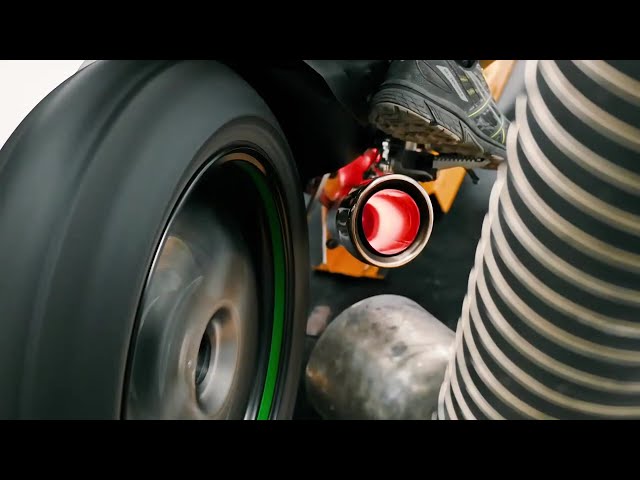
Full titanium exhaust system has a very simple design consisting of the header and collector pipes, a joint pipe, and a straightpipe megaphone-style silencer.

Single-sided Swingarm
Having a single-sided swingarm allows the exhaust silencer to be mounted closer to the bike centreline, ensuring a high bank angle for sporty cornering.

Hydraulic Clutch & Back-torque Limiter
A high-quality hydraulic clutch offers less maintenance, ensuring the initial touch condition can be maintained. And with Brembo components, superb linearity and smooth actuation are also benefits.

Kawasaki Original Silver-Mirror Paint
Kawasaki’s new Highly Durable paint features a special coat that allows scratches to repair themselves, enabling the paint to maintain its high-quality finish†. * Soft and hard segments in the coat work together like a chemical spring, creating a trampoline effect that absorbs impacts. † Notes: 1. In some cases, it takes about one week for recovery. 2. The paint will not recover in the case of scratches caused by a coin or key, or zip fasteners.

Cylinder Head
A number of considerations were given to the cylinder head design to ensure the cooling performance needed for the supercharged engine. The large coolant passageways result in the ideal cooling for the combustion chamber.

Ram Air Intake
Air supplied to the supercharger enters via dual Ram Air intakes in the upper cowl. Their total frontal area is approximately 13,000 mm2—illustrating just how much air is needed to achieve the over 300 PS output.

Kawasaki River Mark
Special permission was obtained to use the River Mark on the Ninja H2R. Usually, its use on a product is reserved for models of historical significance.

Trellis Frame
Using a trellis frame construction offered an elegant, lightweight solution to meeting the performance requirements for the chassis.

Oil Jets
In the interest of keeping the engine compact and simple, a single lubrication system provides cooling oil for the engine components, supercharger and transmission.

Bank angle display
New instrument features include bank angle display and max bank angle recording function (possible thanks to the addition of the Inertial Measurement Unit)

KQS (Kawasaki Quick Shifter)
The Ninja H2R was the first Kawasaki motorcycle to be fit standard with a quick shifter. For 2017, the quick shifter also enables clutchless downshifts.

KCMF (Kawasaki Cornering Management Function)
KCMF monitors engine and chassis parameters throughout the corner—from entry, through the apex, to corner exit—modulating brake force and engine power to facilitate smooth transition from acceleration to braking and back again, and to assist riders in tracing their intended line through the corner. On the Ninja H2, KCMF oversees the following systems: - KTRC (including traction, wheelie and sliding control) - KLCM - KIBS (including pitching and corner braking control) - Kawasaki Engine Brake Control

Riding Position & Ergonomics
The riding position was designed for riding at ultra-high speed and circuit riding. To help support the rider during intense acceleration, hipsupporting pads flank the rear of the seat. The hip support is adjustable 15 mm backward to suit rider size.

Brembo Brakes
A pair of massive Ø 330 mm Brembo semi-floating discs with a thickness of t5.5 mm deliver superb braking force.

Öhlins TTX36 Rear Suspension
The addition of Öhlins’ highly acclaimed TTX shock offers numerous rider benefits: - Increased rear stability - excellent damping and increased riding comfort - Increased rear stability - Superb feedback from the road - More stability at speed.

Öhlins Electronic Steering Damper
Kawasaki’s electronic steering damper was jointly developed with Öhlins, one of the most popular and respected manufacturers of steering dampers.

Bosch IMU
The use of Bosch’s compact IMU allows an additional layer of precision to be added to the already high-level KTRC, KLCM and KIBS.IMU enables inertia along 6 DOF (degrees of freedom) to be monitored. Acceleration along longitudinal, transverse and vertical axes, plus roll rate and pitch rate are measured.
Images
3 photos


Colours
1 finish
Videos

About the Ninja H2R
- 4 Years warranty